
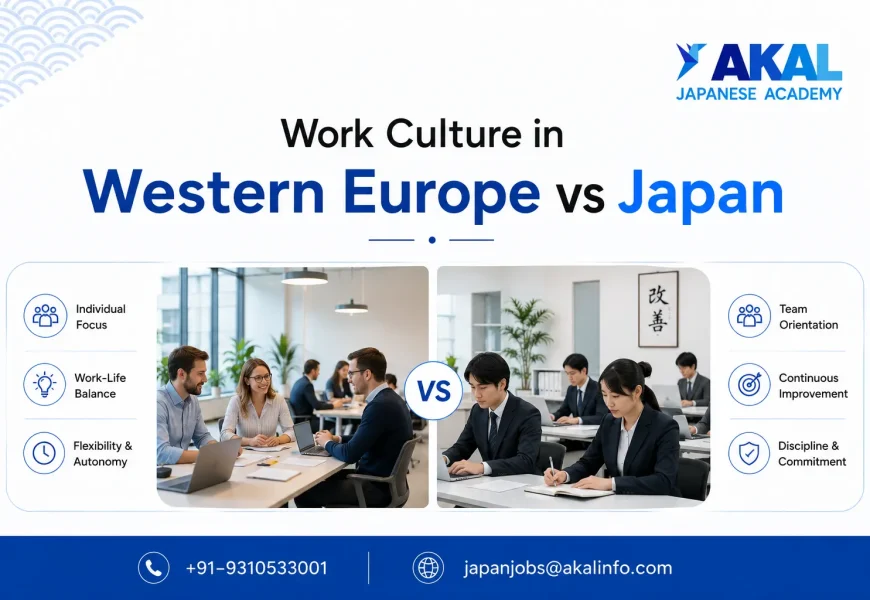
For any CEO, CHRO, or CXO running operations across both regions, work culture is not an abstraction; it shows up directly in attrition rates, M&A integration timelines, productivity benchmarks, and the speed at which decisions get made.
Western Europe and Japan represent two of the world’s most economically advanced labor markets, yet they have arrived at almost opposite answers to questions like how long people should work, who gets to decide, and what loyalty to an employer actually means. This piece lays out the data, the structural reasons behind it, and what it means for leaders managing distributed teams in 2026.
Why This Comparison Matters Right Now
Labor law in both regions is particularly dynamic in 2026. The EU is getting closer to the implementation deadline for its Gender Balance on Corporate Boards Directive, several member countries are conducting four-day working week experiments paid for by their governments, and the EU Working Time Directive remains unchanged, setting the limit for hours worked per week to 48.
Japan is currently experiencing an actual struggle for its identity: the 2019 Work Style Reform Act reduced maximum working hours, yet the new Prime Minister, Sanae Takaichi, who took office at the end of 2025, challenged the concept of promoting work-life balance language and considered further exemptions to discretionary hours of work. This becomes a serious challenge for any executive managing an international team, as it directly influences cost and risks related to hiring and cultural considerations when managing teams in either country.
9 Defining Differences in Work Culture Between Western Europe and Japan
1. Decision-Making Culture: Consensus-Building vs Flatter Hierarchy
Japanese corporate decision-making is still substantially shaped by ‘nemawashi’ (informal groundwork) and ‘ringi‘ (a formal, multi-level written approval process). Before a proposal ever reaches a meeting, a manager will typically have already had one-on-one conversations with every stakeholder who could object, so that the meeting itself confirms a decision rather than debates one. This produces high implementation buy-in once a decision is made, but it is slow, and the process can take weeks for decisions a Western European company might finalize in a single meeting.
Western European organizations, especially in the Netherlands, the Nordic countries, and German “Mittelstand” companies are more likely to follow quicker decision-making processes, with responsibility and authority being delegated down further than in other organizational models. Although hierarchy remains intact (for example, Germany and France have more hierarchical cultures than the Nordic countries), the requirement to reach a consensus before the meeting is much less established than in Japan.
What this means for leaders: A reorganization or product launch that takes six weeks of stakeholder alignment in Tokyo might take six days in Amsterdam. Rolling out a single global change-management timeline across both regions without adjusting for this is one of the most common causes of friction in multinational rollouts.
2. Working Hours and Overtime Norms
The legal limit in Japan is set at 40 hours per week, which is comparable to the majority of Western Europe. However, the difference in attitudes towards working overtime and in its enforcement makes the two regions significantly different from each other. According to the Japanese Act on Improvement of Working Styles Through Systematic Implementation of Reform (Work Style Reform Act), which came into effect in April 2019, the maximum number of overtime hours allowed within the so-called “36 agreement” is limited by 45 hours a month and 360 hours a year, although there is an allowance for extreme cases when workers can work up to 100 hours in one month. Western Europe operates under the EU Working Time Directive, which caps average working time at 48 hours per week, including overtime, but most member states set considerably lower statutory or collectively bargained norms. France’s legal workweek is 35 hours; Germany and Denmark run roughly 37–40, and several “right to disconnect” laws (France, Belgium, Portugal) legally protect employees from after-hours work contact.
3. Work-Life Balance and Leave Culture
Paid-time off systems in Western European countries are seen as benchmarks across the globe. Four weeks is the minimum number of paid annual leave under EU legislation; it means more than 20 days. In some countries, such as Austria, Spain, and France, there are many more days, with the result that collective agreements ensure 28 to 36 days per year.
The starting point of Japan’s minimum entitlement is merely 10 days for a period of six months’ employment, increasing with more years to work up to a peak of 20 days for a period of around 6.5 years. However, the larger problem does not lie with the minimum that the law provides but with the usage. Pressure from society not to inconvenience colleagues has been termed “leave shame”, leading to very few days of paid leave being taken by the Japanese.
4. Remote and Hybrid Work Adoption
This is one of the sharpest and most counter-intuitive divides in 2026. In Western Europe, especially the Netherlands, Ireland, Finland, and Germany, remote work on a partial basis has become normalized, with majority of workers in these regions working from home for at least some days in the week, with around half of all firms seeing no changes to their existing hybrid policy.
Japan tells the opposite story. Indeed, while the coronavirus pandemic compelled the increase in telecommuting, the recovery to pre-pandemic levels was swift: in one study carried out in 2026, it emerged that as many businesses in Japan have ceased providing the option for employees to work remotely, while manufacturing and retail are two industries in Japan where telecommuting is inherently impossible. Such an explanation often offered to explain the difference in preferences towards telecommuting is that Japan puts more weight on face-to-face interaction than management-by-results practices used in Western Europe.
5. Employment Structure
The post-war Japanese economy was based on three fundamental aspects:
- Hiring new graduates simultaneously
- Seniority salary, and
- Lifelong employment at one employer.
The above system is currently disintegrating amid demographic trends. Non-regular employees’ share in the total Japanese labor force is expected to cross 40% for the first time ever by 2026. Moreover, switching employers has become much more common than before – even among workers approaching their mid-forties or fifties. However, due to chronic labor shortages (a less than 3% unemployment rate and a jobs-to-job-seekers ratio higher than 1.2), the government has recently increased the age limit for mandatory retirement-related employment protection up to 65 years and encouraged employing more elderly workers (with almost 26% of over-65-year-olds currently working in Japan).
Labor mobility, bargaining strength, and works councils have been pushing for greater flexibility, family-friendliness, and part-time work arrangements in Western Europe (The Netherlands, for example, has one of the highest rates of part-time employment in the OECD). On average, job tenure is shorter, and changing employers does not bring about much social stigma as seen in the traditional Japanese company.
6. Productivity and Output per Hour
While Japan is well-known for its culture of long working hours, productivity measures show a different picture. According to the data from the OECD on GDP per hour worked (2023, adjusted by PPP), Germany ($93.81), the Netherlands ($94.38), Austria ($94.96), and even France ($88.15) significantly outrank Japan ($56.26) in terms of productivity per hour worked.
Allowing for slower digitalization in some economic sectors of Japan, an older demographic in the country, and the tendency of their economy to value seniority rather than productivity in employees, Japan is at the bottom of the G7 on this measure.
7. Employee Engagement
According to the Gallup State of the Global Workplace studies, Western Europe has been consistently found to be one of the most disengaged regions in the world, with engagement levels standing at about 13-14%, which translates to only about half of what is observed in North America.
Engagement scores measure employee involvement and workplace sentiment rather than direct productivity outcomes. On the other hand, East Asia, which serves as the benchmark region for Japan in the Gallup studies, is situated at the same low level. Across the globe, Gallup’s 2026 report observed that engagement was on a downward trajectory for the second consecutive year to reach only 20%, mainly owing to poor manager engagement.
8. The Four-Day Workweek and Working-Time Reform
The movement towards a global four-day working week starts in Western Europe in 2026. There is a legal provision in Belgium for a request for shorter workweeks, while in Germany, France, Spain, and Portugal, pilot projects are conducted. In January 2026, Poland initiated a project supported by the government which involved over 5,000 workers within a 12-month period. All the pilot projects use the same principle: focus on results rather than hours spent at work, and productivity does not decline in such cases.
Japan is experimenting too; Microsoft Japan in 2019 revealed productivity gains of 39.9% on a four-day schedule, but other companies such as Panasonic and Fast Retailing have undertaken their own experiments with shorter weeks. However, implementation occurs on a far smaller scale and is politically more controversial than in Western Europe.
9. Gender Representation in Leadership
In Western Europe, which owes much to regulation, considerable progress has been made in board diversity: in France, there is 44–45% representation of women on boards; the European Union’s Gender Balance on Corporate Boards Directive calls for at least 40% representation of non-executive directors in the entire bloc, with the current average of the EU-27 countries standing at 35%, by mid-2026. In contrast, progress towards making women more involved in executive than merely non-executive positions is slower.
Here, the level of disparity between men and women is much more pronounced. Only about 11 to 15 percent of female executives are in charge of senior executive roles in major companies listed on Japan’s prime market, and the country itself is not close to meeting the set goals, having missed them several times (originally it planned to achieve 30 percent by 2020, but that was moved to 2030).
Side-by-Side Comparison Table
Strategic Implications for CEOs, CHROs, and CXOs
A few patterns are worth pulling out explicitly for leaders making structural decisions across both regions in 2026:
Don’t mistake hours for output. Long work hours in Japan also exist alongside a lower GDP per hour worked than most major Western European countries. Performance evaluation systems based on attendance over output will be likely to reward the wrong people in both contexts, but that danger is more inherent to Japan.
Build change-management timelines around decision culture, not headcount. In the case of a global deployment based on decision-making assumptions, you are likely to underestimate the Japanese pace while overestimating in Western Europe.
Treat manager engagement as the leading indicator, not employee engagement. According to Gallup’s findings, most of the drop in global engagement can be explained by the disengagement of managers, which is something that HR can have more direct influence on.
Regulatory exposure is diverging, not converging. Compliance is getting harder in Europe owing to the EU’s board diversity directive, work time laws, and right-to-disconnect rules, but the current trend in Japanese politics seems to be heading in the opposite direction when it comes to working hours regulations, a very unusual divergence to watch out for in planning for 2026-2027.
The four-day workweek is a Europe-led trend for now. Businesses implementing shorter working hours on an experimental basis across the globe would find it easier to do so in Western Europe compared to Japan.
Gender diversity strategy needs region-specific targets. A single global board-diversity KPI will look achievable in France and nearly unreachable in Japan without distinct, region-calibrated interim milestones.
Final Words
Western Europe and Japan are not converging on a single global model of work; if anything, 2026 is pulling them further apart. Europe is legislating its way toward shorter hours, mandated board diversity, and outcome-based flexibility. Japan’s current political leadership, by contrast, is openly questioning whether “work-life balance” was ever the right goal, even as the country’s own labour-shortage numbers argue for exactly the opposite direction.
Both regions are wrestling with the same underlying problem, a disengaged management layer quietly eroding productivity, but they are responding to it from almost opposite philosophical starting points: codify and enforce in Europe, persuade and erode gradually in Japan. The mistake most global leaders make isn’t picking the wrong culture to emulate. It’s assuming one culture needs to win. A six-week consensus-building process in Tokyo and a six-day decentralized call in Amsterdam can both be the right call for that market, the failure mode is applying either timeline to the other region by default.
In the year 2026, the firms who will have achieved this effectively will not be those with the most consistent approach to their global strategy. Instead, the companies with effective management teams that know, market by market, what game they are in and do not impose one set of assumptions on both will succeed.