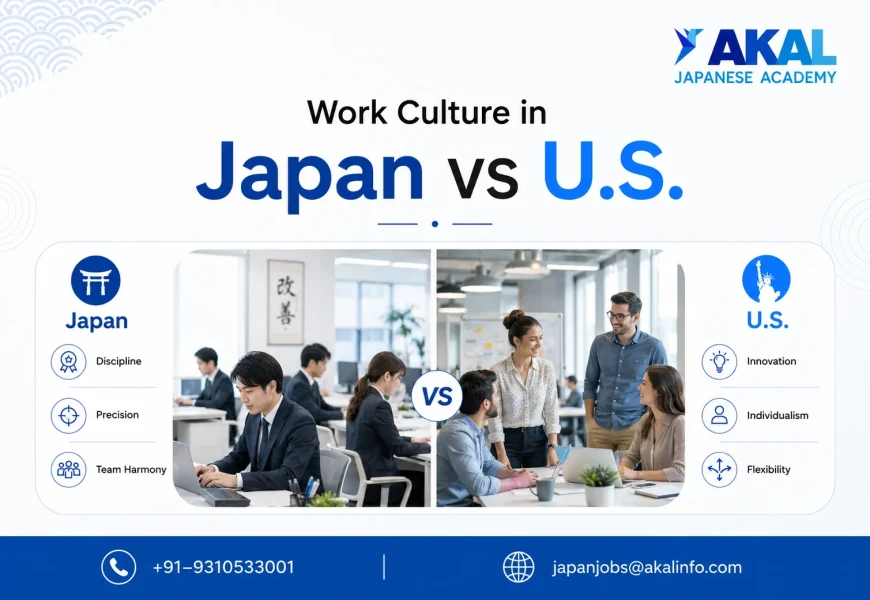
The comparison between Japanese and American work cultures for many years was based on the simple contrast between the collective nature of Japanese work life and the individualistic nature of the American one. Japan brought us the salaryman: disciplined, hierarchical, stoic, and always working. America brought us hustle culture: enterprising, nomadic, self-promoting, and achievement-orientated.
But as of 2026, that binary is breaking down in ways that matter profoundly for business leaders. This blog dissects the structural, cultural, and strategic differences between Japanese and American work culture across 12 key dimensions.
- How People Think About Work in Japan and the U.S.
- How Teams Reach Decisions
- Working Hours in Japan and the U.S.
- Work Life Balance in Japan and the U.S.
- How Employment Works in Japan and the U.S.
- Management Styles in Japan and the U.S.
- How Innovation Works in Japan and the U.S.
- Employee Engagement in Japan and the U.S.
- Remote and Hybrid Work in Japan and the U.S.
- How Employees Are Paid in Japan and the U.S.
- How Diversity Is Changing the Workplace
- How Gen Z Is Changing Work Culture
- Japan and U.S. Work Culture at a Glance
- How Companies Can Succeed Across Both Markets
- Final Thought
How People Think About Work in Japan and the U.S.
The single biggest driver of divergence between Japanese and American work cultures is not law, not compensation, and not technology; it is cultural philosophy.
Japan: The Group Before the Self
Japanese work culture is rooted in ‘wa’ (和), the principle of group harmony. This manifests as deep collectivism: individuals subsume personal preferences to the needs of the team, the department, and ultimately the company. Mistakes are rarely admitted publicly to preserve face (both one’s own and the group’s). Decisions are not made by individuals but by consensus, a process known as ‘nemawashi’ (informally building agreement before a formal meeting) followed by ‘ringi’ (a formal approval chain where decisions travel upward through multiple levels).
These qualities make the culture of collectivism very strong in its benefits – great team spirit, high attention to quality, and preservation of corporate experience. However, they also make it slow and conservative.
United States: The Individual as the Unit of Performance
American organisations are individualistic in their structure. The job description is the contract, the performance review is the verdict, and career progression is mostly a matter of individual achievement and self-advocacy. American workers are taught to differentiate themselves, to self-promote, to move laterally or vertically in a company or from one company to another in pursuit of better compensation and faster advancement.
This individualism creates innovation, speed, and flexibility. However, it also creates fragmented knowledge of institutions, high turnover, and a culture where personal success may be attained at the cost of team performance.
What This Means for Leaders: Organizations working across both markets must understand that neither model is universally superior. The collective culture in Japan offers certain strengths as far as quality control, production cycles, and relationships are concerned. In contrast, the individualist culture of America excels in terms of innovation and growth.
How Teams Reach Decisions
Japan: Consensus-Driven, Top-Down in Structure
The Japanese workplace is explicitly hierarchical, and this hierarchy is ritualised. The senpai-kōhai (senior-junior) system governs workplace relationships, knowledge transfer and even daily communication. Juniors are expected to show respect through the use of formal language (keigo), specific seating arrangements at meetings, and the exchange of business cards (meishi koukan) in a prescribed manner. No employee can make a decision without consulting the superiors. ‘Ho-ren-so’ (報・連・相 — report, contact, consult) is a practice for upward communication.
The result: Decisions are slow but broadly accepted once made, since they were reached after consensus-building. Through the ringi approach, one decision alone can be approved through 8-12 stages.
United States: Flat-ish Hierarchies, Fast Decisions
American corporate culture, especially in tech and the professional services, tends to value less hierarchy, more direct communication, and rapid iteration. Managers are expected to be available, and employees at all levels are encouraged to share ideas, challenge assumptions and make decisions within their authority. Senior leaders often have open-door policies, and “disagree and commit” is a well-known cultural norm (famously embodied in Amazon’s leadership principles).
Comparison Table: Decision-Making Styles
| Dimensions | Japan | United States |
| Primary Decision Unit | Group / Team | Individual / Manager |
| Process | Nemawashi → Ringi (slow, consensus) | Top-down or collaborative (fast) |
| Risk Tolerance | Low — avoids decisions without certainty | Moderate to High — “fail fast” culture |
| Communication Style | High-context, indirect | Low-context, direct |
| Conflict Resolution | Avoided / mediated through hierarchy | Addressed openly, sometimes aggressively |
| Meeting Purpose | Consensus confirmation | Information sharing + live decision-making |

Working Hours in Japan and the U.S.
This is perhaps the most globally scrutinized dimension of Japan’s work culture, and the data in 2025–2026 tells a complicated, evolving story.
Japan: The Karoshi Legacy and Legal Reform
For most of the 20th century, Japan held the grim distinction of working the longest hours in the developed world. The phenomenon of ‘karoshi’ (過労死 — death by overwork) became a global symbol of this excess. In FY2024, Japan’s Ministry of Health, Labour and Welfare officially recognized 1,304 cases of overwork-related deaths and health disorders; it is the highest figure on record, and an increase of 196 year-on-year. Of these, 1,057 involved depression or other mental health disorders, and 89 involved suicide or attempted suicide.
One in 10 Japanese workers still logs more than 80 hours of overtime per month, a threshold recognized by the government itself as a serious health risk. One in five is considered at risk of karoshi.
In response, Japan enacted significant labor law reforms:
- Work Style Reform Act (2019): The monthly limit for overtime was 45 hours and 360 hours annually for everyone.
- Healthcare Worker Guidelines (2024): The annual limit for doctors was 960 hours of overtime.
- Tokyo Metropolitan Government (2025): It adopted a four-day work week for more than 160,000 government workers with 80 percent of working hours and
However, despite these measures, the enforcement of these cultural practices is uneven. “Service overtime”, where workers voluntarily work without pay due to cultural norms, is prevalent in practice.
United States: Long Hours by Choice (or Pressure)
The United States is the only OECD country without a federal limit on the number of hours salaried workers may work. The “hustle” culture has long celebrated overwork as a sign of ambition. But in the U.S. the average annual hours worked in 2026 are about 1,810, higher than Japan’s 1,654. American working professionals check email after 10 p.m.; meetings after 8 p.m. are up 16% year-over-year, according to Microsoft Workplace data.
Burnout costs American businesses an estimated $322 billion annually in lost productivity (The Interview Guys, 2025). Burned-out employees are nearly 3x more likely to plan to leave within a year.
The Convergence Point
In a surprising reversal, the average Japanese worker now logs fewer annual hours than the average American worker, who are driven by legal reform in Japan and an “always-on” digital culture in the U.S. This is not yet a cultural shift in Japan, but it is a legal and structural one. In the U.S., it reflects a crisis of boundary-setting in hybrid and remote environments.
Work Life Balance in Japan and the U.S.
Japan’s Nomikai Culture and Its Hidden Costs
‘Nomikai’ (飲み会—obligatory drinking parties after work) have been a traditional practice; it is a form of social bonding and an implicit loyalty test. Rejecting an invitation to join a nomikai from a higher-up poses difficult diplomatic decisions. These meetings prolong the workday by 2–3 hours and affect, more so, women, young workers, and those with dependants.
Work-life balance in Japan has a score of only 3.4 out of 10 in the global index, which is one of the worst scores for a developed nation. One area where this factor is especially clear is gender equality, with the average difference between male and female salaries in Japan at 22%, the worst figure of all 36 OECD member countries. Work-life balance issues are directly tied to demographics in Japan.
U.S. Work-Life Balance: Flexibility in Theory, Intensity in Practice
The flexibility provided by the U.S. is far greater, especially in the post-COVID era. Almost 52% of employees who can work remotely in the U.S. are found to be working in hybrid positions (Gallup, 2025), and it seems that the hybrid model is emerging as the “de facto standard” for white-collar professionals. But this added flexibility does not seem to have helped create any balance either. Workers who work remotely face 61% burnout, while those who work in hybrids (57%) and on-site face it (55%), respectively (Eagle Hill Consulting, 2025).
Over a quarter of all United States employees (28%) now rank work-life balance as their top motivator at work (SurveyMonkey, 2025). However, for more than a third of HR professionals, exhaustion is the main reason for staff attrition (36%).
Key Takeaway for CHROs
Neither of the two nations is able to find a solution to achieving a proper work-life balance. The challenge for Japan is structural in nature (cultural norms are resistant to change), while that of the United States is technological (tools are used to blur the boundary between life and work). The highest-performing organizations in both markets are those investing in structured flexibility – defined hours, communication protocols, and manager-led accountability. Rather than unlimited autonomy or rigid office mandates.
How Employment Works in Japan and the U.S.
Japan: The Declining Ideal of Lifetime Employment
Japan’s post-WWII employment model was built on shūshin koyō (終身雇用), which means “lifetime employment”. Workers, especially those employed by big corporations, were supposed to enter a corporation after graduation and stay there until retirement, receiving annual salary increases according to seniority (nenkō joretsu). This kind of employment system resulted in great loyalty and organizational stability, but, at the same time, there were some rigidities: poor performers could not be easily dismissed, and high performers could not be promoted ahead of their seniority class.
According to a 2025 survey, 79.5% of the companies in Japan hired or intended to hire mid-career employees, compared to around 60% a decade back. It shows that the trend towards adopting an employment system based on qualifications rather than the traditional lifelong employment system continues to grow fast among the larger organizations (5,000 or more employees). However, for the millions of workers employed at small and medium enterprises (which make up over 99% of Japanese businesses), the old model persists.
United States: At-Will Employment and the Talent Marketplace
The U.S. follows the at-will employment system, which implies that employers and employees can break off the contractual relationship at will for any legal reason. Thus, there is considerable labor market flexibility, and changing jobs is neither considered improper nor a waste of effort; indeed, research proves that moving from one employer to another leads to salary increases in comparison with promotion.
Such fluidity promotes innovation and specialization, but it poses a number of problems related to knowledge retention, high costs associated with onboarding and, consequently, loss of institutional memory. The replacement of an employee may cost 50-300% of his or her annual salary.
What’s converging?
Japan is shifting towards a skills-based or merit-based job system. While in the U.S., companies are starting to pay more attention to retention because of the costliness of turnover. Both systems are evolving slowly towards a system where loyalty and performance are combined.
Management Styles in Japan and the U.S.
Japan: The Authority of the Senpai
Japanese management is rooted in the senpai-kōhai hierarchy. Senior employees are expected to mentor and guide juniors, not just manage output. The manager’s role does not involve coaching staff as much as it involves being a senior organizational member. Criticism is not openly offered but is communicated indirectly through suggestions or hints. Directly disagreeing with the manager is considered unacceptable.
While this brings about consistency and mentoring, it also stifles criticism from superiors, discourages innovation which is not in accordance with established methods, and can cause delays in recognizing poor job performance.
United States: Results-Oriented and (Theoretically) Direct
American management culture is based on measurable output, direct feedback and personal accountability. Employees are responsible for producing results in accordance with their job descriptions and performance measures. Many U.S. companies have formal quarterly or annual performance reviews, OKR (Objectives and Key Results) systems or 360-degree feedback processes. The relationship between manager and employee is professional and largely transactional rather than paternalistic.
Nevertheless, the level of management in America is very varied. According to data from the year 2025, only 32% of employees in America are fully engaged in their jobs, an engagement level that has not changed significantly throughout many years. It can be seen that management level is the critical variable.
How Innovation Works in Japan and the U.S.
Japan’s Kaizen: Incremental Excellence
Japan’s manufacturing and corporate culture gave rise to one of the world’s most influential operational philosophies: ‘kaizen’ (改善 — continuous improvement). The kaizen mentality favours incremental, iterative change over disruptiveness. These principles, plus genchi genbutsu (go and see for yourself) and gambari (perseverance), have underpinned Toyota’s production system, Honda’s quality engineering, and Sony’s manufacturing precision.
Kaizen functions very effectively in situations where processes have been defined, are repetitive, and are quality-conscious. It functions poorly in situations where markets call for quick changes and creativity.
U.S. Innovation Culture: Fail Fast, Scale Faster
Corporate culture in the United States, especially Silicon Valley and the broader technology sector, values speed, experiments, and a tolerance for failures. The idea of the MVP (minimum viable product), pivoting, and “moving fast and breaking things” represents an approach to risk which is entirely different from that followed by many companies around the world. Here, failure is not shameful but simply indicates the need for learning. This results in greater innovations, more failures, and a system which prioritizes speed over perfection
What Leaders Should Borrow from Each: Kaizen practices are being gradually incorporated into operations within American manufacturing companies, healthcare providers, and logistics organizations. American lean startup theory is gradually gaining traction among tech startups and entrepreneurial ventures in Japan, especially within the rapidly developing venture capital industry in Tokyo. The best-performing companies worldwide are combining both concepts—quality management and experimentation.
Employee Engagement in Japan and the U.S.
The statistics relating to engagement of employees in Japan and the United States are astounding and have serious implications for anyone managing a team in both countries.
Gallup’s State of the Global Workplace (2025) data:
- Japan: Some 6% of workers are actively engaged on the job, one of the lowest figures in the world. It ranks among the worst of all OECD nations in this respect.
- United States: Around 32% of workers are actively engaged. Better than in Japan, but 68% are either not engaged or actively disengaged.
This creates an impact that goes on to create further implications. Unengaged employees result in loss of production efficiency, absenteeism, employee turnover, and poor customer results. For instance, in Japan, lack of engagement is entrenched in organizational culture since meritocracy in career progression is absent; hence, performance and personal drive are not rewarded for many years.
In the US, differences in employee engagement are wide across industries, management effectiveness, and company cultures. Companies that focus on recognition, development, and effective managers always surpass their competition. The companies listed on the Fortune 100 Best Places to Work in 2025 have a productivity level almost 42% higher than an average American organization, and 97 out of 100 organizations allow telecommuting and hybrid working models.
Remote and Hybrid Work in Japan and the U.S.
Japan: Return to Office, with Resistance
Japan’s adoption of remote work surged during COVID-19 but has since partially retreated. By 2026, an estimated 70% of companies in Japan will no longer provide remote working as a regular choice. Hybrid work has become common practice for the office workers of Tokyo, but there is a cultural pressure to be physically present despite productivity levels.
Furthermore, Japan’s manufacturing-based economic structure does not allow for extensive use of telecommuting among other large sections of the population. Retail, manufacturing, and hospitality industries, each employing a large number of the Japanese labor force, do not support telecommuting.
United States: Hybrid as the New Default
Hybrid is now the established norm when it comes to U.S. office-capable roles. By 2025, 52% of U.S. remote-capable employees have hybrid roles, while 27% work fully remotely, and 21% work fully on site. Listings for hybrid jobs rose from 15% of total listings during Q2 2023 to 24% in Q2 2025. On the other hand, listings for fully on-site jobs fell from 83% to 66%.
The business case is now well-established: hybrid workers are 33% less likely to quit (Stanford, Bloom 2025), and remote job postings attract 340% larger candidate pools. A Stanford study published in Nature found zero negative impact on performance from hybrid arrangements and a 33% drop in turnover.
How Employees Are Paid in Japan and the U.S.
Japan: Tenure-Based Pay in Transition
Traditionally, Japanese organizations compensated employees based on seniority rather than performance. Under the “nenkō joretsu” (年功序列) system, employees earned higher salaries as they spent more years with the company. For example, an employee with 10 years of service typically received greater remuneration than someone with five years of experience, regardless of individual productivity or merit.
But this system is slowly changing. As studies conducted in the year 2025 show that 79.5% of firms are using or are going to hire mid-career workers, which shows the shift towards performance-based payment. The regional minimum wage of Japan has been raised by 5% in 2024, which is the highest rise in the past two decades, and there is also an anticipated 5% rise in 2025 so that the minimum wage would be 1,500 yen per hour.
United States: Performance-Based and Market-Driven
The remuneration system in America is one that is based on the market, performance, and high levels of variation. Salaries are based on market information, not years of service; bonuses are performance-driven, individual or collective, and there are stock options within expanding businesses. The transparency in the American labor market, fueled by salary laws in California, Colorado, and New York, is leading to more pay equality.
However, the United States has its own compensation equity problems. The gender pay gap persists, racial pay disparities are well-documented, and executive-to-worker pay ratios have expanded significantly over the past two decades.
How Diversity Is Changing the Workplace
Japan: Structural Homogeneity Under Pressure
Japan’s workforce has historically been among the most homogeneous in the developed world in terms of design. The new graduate recruitment system (shūkatsu) historically favored Japanese nationals from elite universities who could demonstrate cultural conformity. Women were expected to leave the workforce upon marriage or childbirth.
Japan’s working-age population is projected to shrink 40% by 2065, creating acute labor shortages. Womenomics initiatives and subsequent policies have pushed female employment to record levels: a 55.1% female employment rate as of Q2 2025 (OECD). Japan has also expanded foreign worker programs, though foreign worker turnover remains 25–35% within 3 years. Almost entirely due to cultural friction and lack of career progression clarity.
United States: DEI Investment Under Political Scrutiny
The U.S. outpaces nearly all developed countries in its infrastructure for DEI, designated personnel, supplier diversity initiatives, pay equity reviews, and ERGs (employee resource groups). However, 2025–2026 has witnessed a major setback to federal DEI progress and growing political pressure on private firms’ DEI initiatives after some landmark decisions at the Supreme Court level and in regulation.
Even amid such volatility, the demographic reality of inevitable majority-minority status in the United States by 2045 means that companies must continue to invest in their DEI initiatives just to survive and compete.
How Gen Z Is Changing Work Culture
Perhaps the most important convergence force between Japan and the U.S. is generational. Gen Z workers are now entering the workforce in both countries in significant numbers, they share a cross-cultural set of expectations that conflict with the dominant norms of both systems.
What Gen Z workers globally demand:
- Purpose over prestige. They want to understand the “why” behind their work, not just execute tasks.
- Mental health acknowledgment. They are more likely than any previous generation to name mental health as a non-negotiable workplace concern.
- Flexibility as a standard. As per the 2025 Deloitte survey, 65% of Gen Z and Millennials will quit their jobs if pushed to return to the office full-time.
- Rapid feedback and development. They want to discuss their careers regularly; they do not want annual reviews.
- Ethical alignment. Corporate social responsibility and environmental commitments matter to their employer choice.
In Japan, this plays out as young workers increasingly opting out of the salaryman track, pursuing freelance or startup roles, and refusing nomikai culture. In the U.S., Gen Z is the generation reporting the highest burnout rates (66%), hitting peak burnout at age 25, 17 years earlier than the average American worker (The Interview Guys, 2025).
This generational reorientation is forcing both organizations and governments in both countries to respond, not as a “talent trend” to manage, but as a structural labor market shift that demands systemic redesign.
Japan and U.S. Work Culture at a Glance
| Dimensions | Japan | United States |
| Core Value | Collective harmony (wa) | Individual achievement |
| Decision-Making | Consensus (nemawashi, ringi) and slow | Direct, delegated, and fast |
| Hierarchy | Explicit, seniority-based (senpai-kōhai) | Fluid, merit-justified |
| Work Hours | ~1,654/yr (declining via reform) | ~1,810/yr (rising via digital culture) |
| Employment Model | Lifetime employment (eroding) | At-will (liquid talent market) |
| Overwork Risk | Karoshi — legally recognized crisis | Burnout epidemic — $322B annual cost |
| Remote Work | ~24.8% partial adoption | 52% hybrid, 27% fully remote |
| Employee Engagement | ~6% actively engaged | ~32% actively engaged |
| Compensation Base | Seniority + group bonus | Market rate + individual performance |
| Innovation Style | Kaizen (incremental, quality-driven) | Disruption (speed, experimentation) |
| DEI Status | Homogeneous, demographically pressured | Diverse, politically contested |
| Generational Pressure | Opt-outs from salaryman culture | Gen Z burnout + flexibility demands |
How Companies Can Succeed Across Both Markets
For those in business who run their operations internationally, the cultural disparity between Japan and America is not merely something theoretical but is actually a tangible factor which can affect recruiting, retaining emplthat, making decisions, fostering innovation, and boosting employee morale. The following are six tips for succeeding in this endeavour:
-
Don’t export your home culture –
Endeavorican executives run Japanese teams and apply direct feedback, quick decision-making, and individual responsibility without cultural adjustments, there will be opposition, disengagement, and loss of talent. On the other hand, when Japanese executives lead American teams and apply consensual culture and hierarchical structures, they will lose their best talents.
-
Build bicultural leadership competency –
For any company that operates in both markets, the best ROI will be on developing managers who can successfully communicate in high-context and low-context ways, manage individual and group rewards, and practice kaizen and MVP approaches.
-
Use data, not stereotypes, to assess engagement –
In both cultures, disengagement gets underreported formally. Utilize pulse surveys, engagement metrics, and one-on-one meetings anonymously.
-
Treat flexibility as a retention investment, not a perk –
Hybrid flexibility in the United States equates to an 8% salary increase as a retention strategy (Stanford, Bloom). Even minor forms of flexibility in Japan have been shown to make a difference to female worker retention and birth rates.
-
Address overwork as a strategic business risk, not a personal failing –
It does not matter whether we call it karoshi in Japan or burnout in the United States; overwork is not something inherent in a particular culture. Overwork is a sign of bad management that comes at a cost. Companies that manage recovery periods, realistic workload control, and workload disclosure always do better.
-
Design for Gen Z or lose them –
Talent deficits are critical challenges for Japan and the United States in important industries. The companies that transform work based on meaning, growth, adaptability, and psychological safety will develop a multiplier effect to their competitive edge in the coming years.
Final Thought
The narrative arc of 2026 is not that Japan and the U.S. are becoming identical. It is about both countries being forced, due to population shifts, technological advancements, changes in the younger generation’s outlooks, and the necessities of competition – to learn from each other’s best qualities and leave their worst behind.
Japan’s extraordinary capacity for team cohesion, quality discipline, and long-term institutional thinking is genuinely valuable and increasingly rare in a world of short-term thinking and high turnover. America’s speed, meritocratic mobility, and innovation appetite are competitive advantages that no amount of kaizen can replicate organically.
It is not the companies that choose one culture and implement it throughout the world. It is the companies that create an organizational system that brings out the best of the two philosophies: collective responsibility without demotivation, personal responsibility without isolation, discipline of excellence without hierarchy, and quick innovation without the inevitable exhaustion that leads to its destruction.