
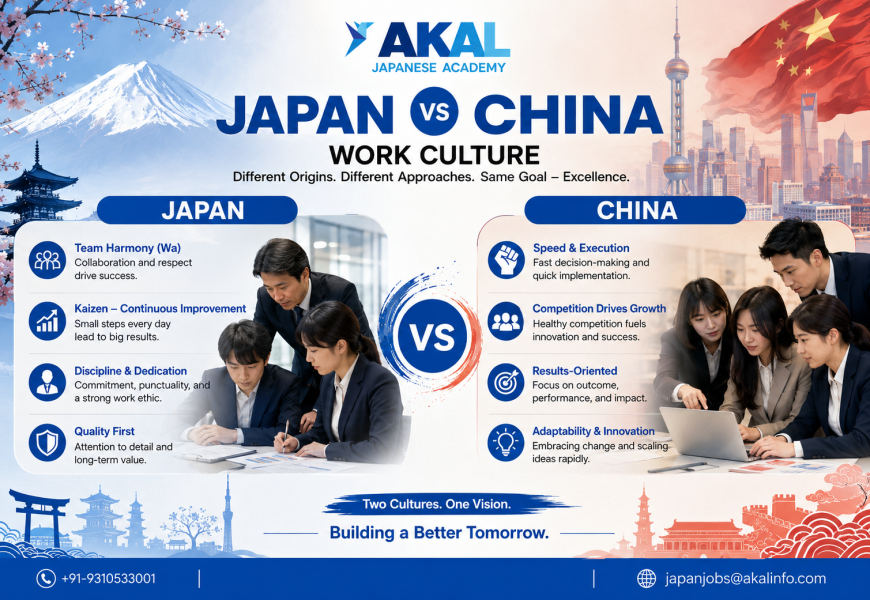
Japan and China are two of the world’s largest economies, but their approaches to work, leadership, communication, and decision-making are fundamentally different.
At a glance, both cultures can look alike to an extent, as they value hierarchy, group identity, and enduring relations. Yet, their approach to decision-making, team management, communication of information, and trust is very different. For business leaders, these differences affect everything from talent strategy and cross-border collaboration to acquisitions, market expansion, and team performance.
This guide compares work culture in Japan and China and explains what leaders should understand before building teams or doing business across both markets.
- Japan vs China Work Culture at a Glance
- What Shapes Work Culture in Japan and China
- How Teams Make Decisions
- Working Hours in Japan and China
- How Leadership Differs
- Job Stability and Employee Expectations
- How People Communicate at Work
- How Gen Z Is Changing Work Culture
- How Teams Approach Innovation
- What Leaders Should Do
- Final Thoughts
Japan vs China Work Culture at a Glance
Japan and China may share certain workplace values such as hierarchy and collective responsibility, but the way these values show up in day-to-day work differs significantly. The comparison below highlights the key differences that shape leadership, communication, employee expectations, and business outcomes across both markets.
| Dimensions | Japan | China |
| Core Values | Harmony continuous improvement | Relationships, reputation, speed |
| Decision Making | Consensus-driven | Top-down and faster |
| Communication | Indirect and contextual | More direct within hierarchy |
| Working Culture | Long hours, traditions, and reform | Fast-paced with performance focus |
| Leadership Style | Consensus builder | Directive leader |
| Innovation Approach | Continuous refinement | Rapid execution |
| Employee Loyalty | Institution and stability | Growth and relationships |
| Gen Z Outlook | Flexibility and balance | Rejecting hustle culture |
What Shapes Work Culture in Japan and China
Both countries have historical roots in Confucian values such as respect for hierarchy, social order, and collective responsibility. However, those values evolved differently over time.
Japan developed a workplace culture centred on process, alignment, and long-term stability.
China developed a business culture that prioritises relationships, adaptability, and fast decision cycles.
Understanding this distinction helps explain why teams in both countries often respond differently to the same leadership approach.
-
Japan and the Value of Harmony
The concept of Wa, or harmony, has a profound impact on Japanese work culture. The goal is usually not individual visibility but team alignment Individuals usually try to prevent conflict and prefer consensus prior to action. Three concepts have a significant impact on working conditions:
- Kaizen: This involves continuous improvement achieved through gradual and persistent effort.
- Nemawashi: This involves informal talks and consultations prior to official decision-making.
- Ringi: An official chain of command involving several decision-making levels.
Although it may make decision-making seem to take a long time, when consensus is achieved, implementation is usually quick.
-
China and the Importance of Relationships
Chinese work culture places strong emphasis on trust networks and social reputation. Two ideas are especially influential:
- Guanxi: Relationships based on trust and reciprocity within the professional sphere.
- Mianzi: Personal integrity, social position, and maintaining respect during dealings.
These concepts affect negotiation, recruitment, promotion, and intra-organisational communication. In many organizations, when there is alignment among the leaders, decisions are fast-tracked.
How Teams Make Decisions
Decision-making is one of the clearest differences between the two cultures and often shapes how organisations operate day to day. Understanding how decisions are discussed, approved, and implemented can help leaders work more effectively and set realistic expectations across teams.
Japan Builds Consensus Before Action
Japanese organizations tend to spend considerable time before making any important decisions. The leaders gather opinions, align the stakeholders, and reduce conflicts prior to the decision-making process. This implies that:
- The decision process takes more time
- Written reports are essential
- Saying nothing does not necessarily imply consent
- Once made, the implementation occurs rapidly
- Leaders coming into Japan confuse preparation with procrastination. Preparation is actually part of the execution.
Many leaders who enter the Japanese market tend to confuse preparation with procrastination. However, preparation is a component of execution.
China Prioritises Speed and Authority
Most Chinese firms act with greater speed when every decision-maker is aligned. Authority in leadership matters more and often relies on internal clout. So what does that mean?
- Rapid decision-making is possible
- Involvement of executives is important
- Relationships help execute decisions
- Teams often expect clear direction.
Delaying until reaching a broad consensus may not be necessary.
Working Hours in Japan and China
Both nations are known for imposing high standards of work, although the origins and forms of these expectations vary over time. It is beneficial for managers to understand this in order to help manage the expectations of their workers.
Japan and the Shift Away From Overwork
Japan was famed for its long working days and the societal implications of being dedicated to work. The country has made several changes by setting limits to working hours. Nonetheless, there are elements within the society that still shape the conduct of people.
Current workplace trends include:
- greater acceptance of hybrid work
- stronger interest in flexibility
- increasing focus on employee wellbeing
China and the Debate Around Hustle Culture
China’s fast-growth economy contributed to the popularity of intensive work schedules in some industries. Recent years have brought greater legal attention and public discussion around working hours. At the same time, speed and ambition remain strong parts of business culture. Many professionals continue to value career acceleration and rapid growth.
How Leadership Differs
Leadership expectations in Japan and China are vastly different due to the fact that concepts of authority, communication, and teamwork are very different in both societies. A successful approach to leadership in one country does not necessarily mean that it will be successful in another. Understanding these different views held by employees about their managers is crucial for any leader.
Leadership in Japan
Typically, in Japanese organizations, leaders will favour employees who are consistent, senior, and aligned with the team. Leaders must:
- Lead without being autocratic
- Protect team harmony
- No confronting in public
- Creating alignment among stakeholders
Leadership influence often comes through trust and process.
Leadership in China
Chinese leaders are often expected to demonstrate the following:
- Decision-making
- Experience
- Self-assurance
- Clear sense of accountability
In general employees expect leaders to give directions and make decisions. The praise is usually public, but criticism remains private.
Job Stability and Employee Expectations
Loyalty in employees differs between Japan and China owing to the historical background, economic setting, and work culture of both nations. Understanding this difference allows the leader to implement retention strategies that specifically suit the expectations of the local employees and do not follow a general approach.
In Japan
Historically, long-term employment has influenced employer-employee relations. Despite the rise in career mobility, there is high value attached to job stability. Job stability involves:
- security
- long-term development
- organisational identity
In China
Career movement tends to be more common. Employees often evaluate opportunities through the following:
- compensation
- growth potential
- manager relationships
- future career outcomes
How People Communicate at Work
The way people communicate at work influences how teams collaborate, resolve challenges, and build trust over time. While both Japan and China place importance on context and professional relationships, communication expectations are not the same. To know how feedback is shared, how disagreement is expressed, and how information moves through teams can help leaders avoid misunderstandings and work more effectively across both cultures.
Japan
Communications are usually indirect. Disagreements can be communicated indirectly by:
- silences
- using soft language
- delayed answers
- indirect suggestions
Interpretation of the surrounding context can be as important as the verbal communications.
China
Communication becomes more direct, especially in a hierarchy, while information tends to be more selective as it travels higher up. Managers looking for truth and open communication must establish an atmosphere wherein workers feel safe talking freely.
How Gen Z Is Changing Work Culture
Younger employees in both Japan and China are changing long-standing workplace expectations around loyalty, career growth, and work-life balance. While the shift looks different in each country, a common pattern is emerging: employees are placing greater importance on flexibility, wellbeing, meaningful work, and greater control over how they build their careers. For leaders, understanding these changing expectations is becoming increasingly important for attracting and retaining talent.
Japan
Younger professionals increasingly prioritise:
- flexibility
- career mobility
- work-life balance
Traditional expectations around lifetime employment continue to evolve.
China
Many younger employees are questioning constant competition and the long-hours culture. Themes becoming more visible include:
- wellbeing
- sustainable ambition
- personal freedom
- redefining success
These shifts are influencing retention and employer branding.
How Teams Approach Innovation
Innovation in Japan and China is shaped not only by business priorities but also by how organisations approach decision-making, risk, and long-term growth. Having knowledge of these differences helps leaders decide when to prioritise speed, when to focus on refinement, and how to build teams that support both innovation and execution.
Japan
Innovation is often built through:
- refinement
- quality improvement
- operational excellence
- long-term consistency
This creates strong reliability and execution discipline.
China
Innovation is often driven by:
- speed
- experimentation
- market responsiveness
- fast iteration
This enables quicker adaptation in changing markets. Neither model is inherently better. They optimise for different outcomes.
What Leaders Should Do
Leading across cultures is not about applying one management style everywhere. The same behaviour that builds trust and momentum in one country may create friction in another. Leaders working across Japan and China benefit from adapting how they communicate, make decisions, build relationships, and manage teams based on local expectations. The following approaches can help leaders work more effectively within each environment.
When working with Japanese teams
- Take time before meetings
- Align yourself early
- Write down decisions
- Be respectful of hierarchy and process
- Better execution after decisions are made
When working with Chinese teams
- Build relationships before important decisions
- Know decision-makers early
- Be direct
- Recognise contributions publicly
- Establish communication channels
Final Thoughts
Even though Japan and China may be frequently mentioned together within a business context, but there is a major difference between the underlying principles of their work cultures with regard to leadership, communications, loyalty, and action. The Japanese culture emphasizes consistency, procedure, and trust. The Chinese culture prioritizes relationships and agility.
Leadership success cannot be obtained by using one particular management ideology in both markets. Success can only be attained by learning about motivation and gaining credibility in both markets.
The organisations that succeed across borders will not be those that force a single way of working. They will be the ones that develop the ability to adapt, earn trust locally, and lead with cultural intelligence.
Understanding the difference is useful. Leading effectively within those differences is where the real advantage begins.